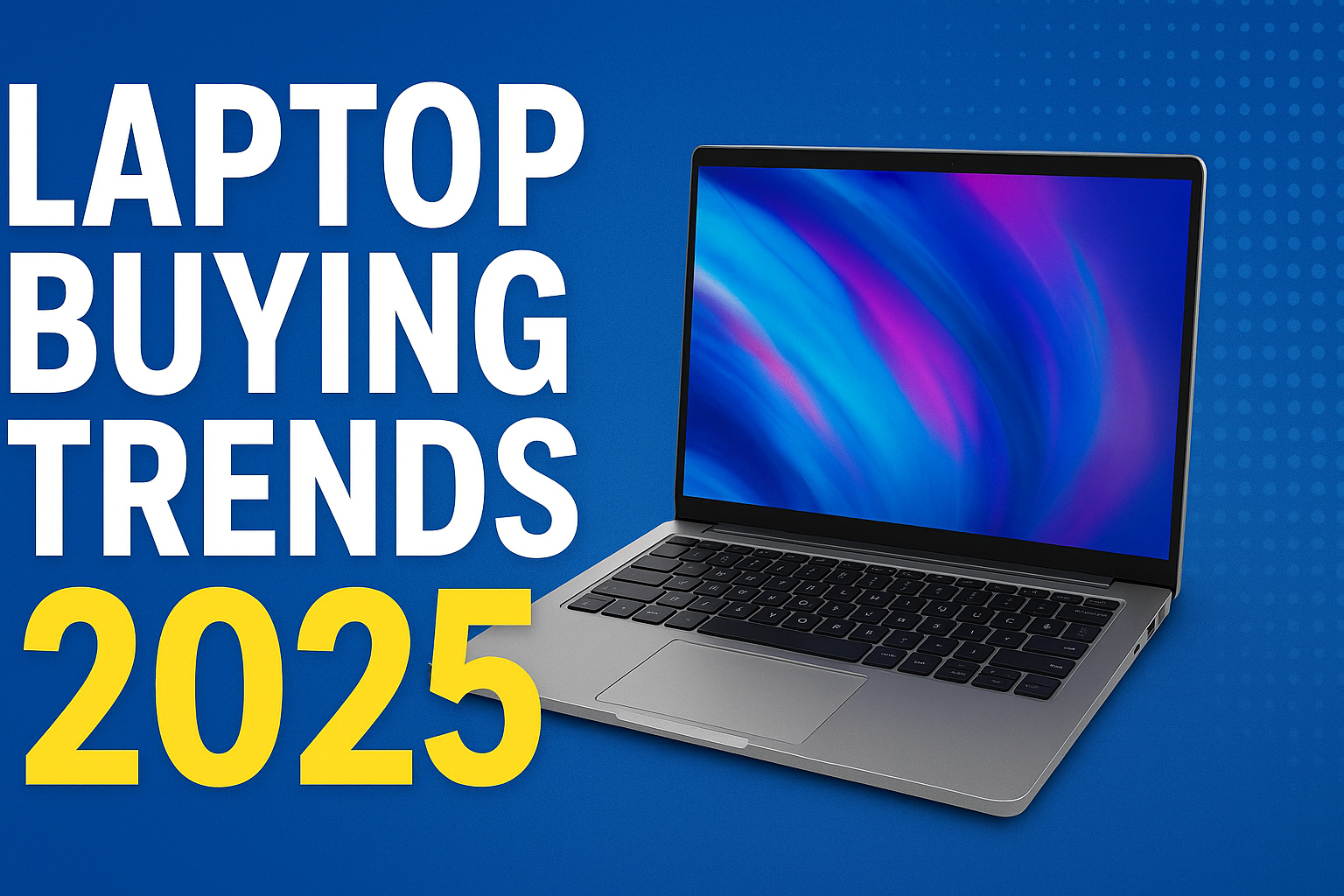
The impact of two forces in laptop buying decisions for 2025 conditions the emergence of AI-enabled devices with neural processing units embedded in the device, and the increasingly persisting demands of hybrid work. Companies are now renewing their fleets to coincide with the Windows 10 end-of-life event and each individual buyer considers whether to invest in premium hardware with promises of longer lifecycle value. This article discusses the current environment of the market, what AI-enabled laptops are keeping in store, consideration of hybrid work on feature priorities, and what is likely to be priority consideration for buyers and vendors alike when laptops are evaluated or positioned in 2025.
Market Context: Stabilizing Demand Around the AI PCs
After several years of volatility, global shipments of laptops are beginning to regain momentum. Canalys reports modest growth in Q2 2025, which is very much driven by refresh cycles in enterprises and heightened interest on AI-ready devices (Canalys, 2025). IDC has forecast that AI-capable PCs will continue to grow as part of a steadily increasing share of global shipments until 2026, as both consumers as well as enterprises adopt it (IDC, 2025).
The significance is clear: the market is no longer expanding only volumetrically. Customers are more sophisticated, and purchase criteria deal increasingly with game-changing features, particularly AI capability and hybrid work readiness.
Re-defining Productivity: AI-Enabled Laptops
From the point of view of Laptop Buying Trends 2025, it is a move toward AI-enabled hardware. While NPUs run applications in the cloud, such performances run locally on laptop machines. An NPU is one of those that could do real-time transcription, intelligent summarization, editing of images or videos, and many other feature potentials within minimum latency employing almost proprietary data privacy (Microsoft, 2024). These NPU embedded PCs are marketed as Microsoft Copilot+ PCs.
Intel’s Core Ultra and AMD’s new AI-optimized processor lines integrate similar features that promise processing power delivery in trillions of operations per second (TOPS), allowing advanced AI tasks to be effectively executed on-device (Intel, 2025).
The business users will measure benefits from AI-enabled laptops that are no longer vague. Measurable value is derived from faster task completion, improved collaboration, and enhanced security while processing sensitive information. The message has shifted from “future potential” to “immediate value,” making AI readiness a core purchase driver.
Hybrid Work Demands: Portability, Security, and Connectivity
Going into 2025, hybrid working has a given place. According to McKinsey research, more than half the knowledge workers across the world today work in hybrid setups (McKinsey, 2025). This mode of work has put a spotlight on distinct laptop features:
- Battery life and portability: Now unmatched are devices that carry an all-day workload without depleting.
- Connectivity: Wi-Fi 7, and even 5G modules, are both some of the features that are marketed as primary prerequisites in order to guarantee continued, seamless collaboration.
- Microphones and cameras: These are improved in picture and sound quality, reflective of the changed world that is continually leaning towards video conferencing.
- Security: Hardware-level protection such as TPM chips and biometric authentication is now a baseline requirement.
As a result, the laptop functions less personally and more adviser, for personal purposes, but now more of a collaboration experience hub. Businesses focus on models that deliver a versatile economy between portability/power/security across widely varying work environments.
Strategic Positioning for Vendors and Retailers
For AI-influenced items in combination with those retained for hybrid work requirements, the visiting strategies of 2025 in companies and retailers will have to comply with that. On the part of businesses, a value narrative mainly focuses on lifecycle cost, fleet manageability, and service agreements. Individual consumers are usually attracted by the direct approach of performance level and AI-related features.
There are three emerging pillars of positioning:
- AI readiness: the actual showing of productivity benefits from NPUs.
- Hybrid Performance: Strengths that implies durability, long-lasting batteries, and safe remote connectivity.
- Support Ecosystems: Offers extended warranties, service contracts, and henceforth enterprise-grade support.
Effective messaging integrates these factors in both marketing and SEO strategies, using terms like AI PCs and hybrid work laptops without excessive repetition of the target keyword.
Buyer Checklist: Reservations in Common Type
Laptops should be evaluated in 2025 on a few good grounds for decision:
- NPU performance (TOPS rating).
- CPU/GPU generation.
- Battery life and charging speed.
- Display quality and portability.
- Security features and compliance.
- Service agreements and warranties.
That’s a good checklist because the benefits from such an investment would carry both short-term productivity as well as long-term lifecycle value.
Conclusion
Laptop purchase in 2025 is no longer through incremental advancements but rather entirely into transformational shifts. On-device AI capability and hybrid-work optimization are the keys to enlightenment for both enterprises and consumers. The clarity vendors will provide in defining the business value of both features, as well as placing such products in real-world buyer needs, will leave demand capture in an increasingly competitive market. Buyers have a strong basis for future-proof investments in AI readiness, security, and hybrid capability.
References
- Microsoft. (2024). Introducing Copilot+ PCs.
https://blogs.microsoft.com/blog/2024/05/20/introducing-copilot-pcs/ - Intel. (2025). AI PCs Powered by Intel.
https://www.intel.com/content/www/us/en/ai-pc/overview.html - McKinsey & Company. (2025). Technology Trends Outlook 2025. https://www.mckinsey.com/~/media/mckinsey/business%20functions/mckinsey%20digital/our%20insights/the%20top%20trends%20in%20tech%202025/mckinsey-technology-trends-outlook-2025.pdf
- Canalys. (2025). Worldwide PC shipments reports. https://canalys.com/newsroom
- IDC. (2025). PC market forecasts. https://my.idc.com
About the Author:
Khubi Agarwal is a passionate Content writer and a certified Digital Marketer with a strong focus on content writing, copywriting and social media marketing. She is a certified Digital Marketing graduate and gained hands-on experience working on various projects involving SEO, content strategy and social media campaigns. As a content writing intern at Market Research Future (MRFR), Khubi combines creativity with strategy to produce engaging content. With a keen interest in staying ahead of digital trends, she loves crafting compelling stories that connect with audiences and drive results.